

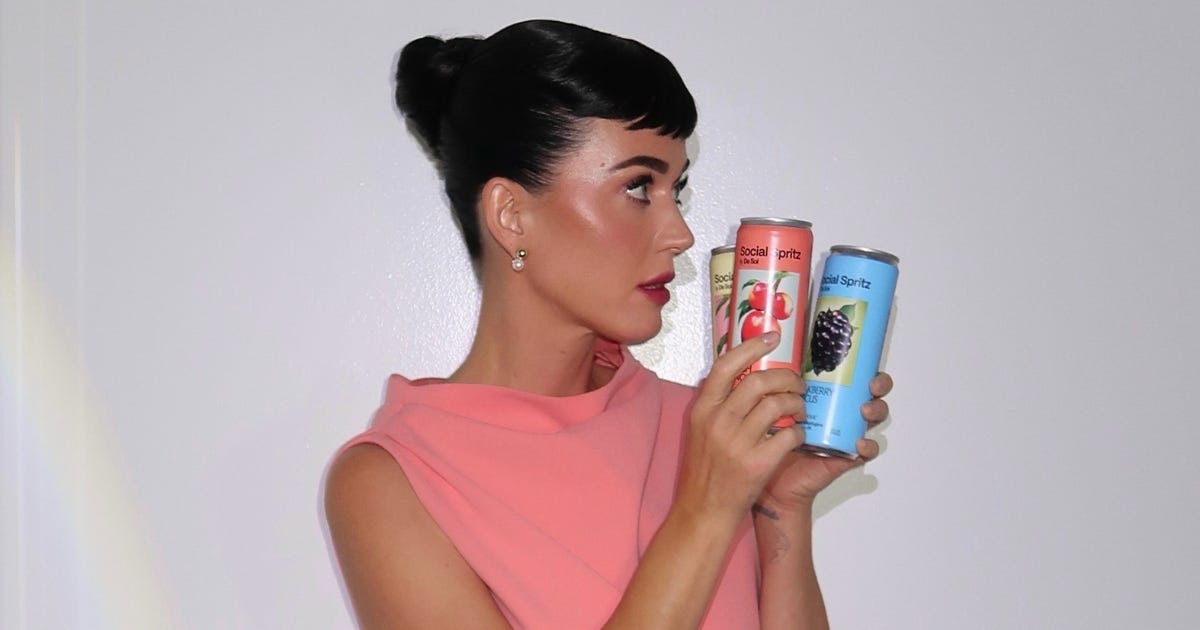
On 3 October, Walmart opened a new section in about a thousand American stores. It is called Mood & Mind, and it sells drinks for focusing, energizing, recharging and unwinding.
“Walmart has a unique ability to help take an emerging trend mainstream,” said its vice president of beverage.
That is what it sounds like when a Second Job stops being second.
Kin Euphorics began selling mood in a drink in 2018, years before mood had an aisle. The trade report on Walmart’s launch named five brands. Kin was not among them.
This is the uncomfortable sequel to everything Parts I and II described. A Second Job is most exposed at the moment it starts working, because success shows the category exactly what to copy. Challengers copy the claim. The leader launches its own version. A retailer builds a shelf. Customers start to expect it. The premium shrinks, and the Second Job becomes the first.
A Second Job has a shelf life. Being early to one is not the same as owning it.
Part II ended by asking which second jobs are still open. The honest answer starts with a harder question: if you find one, can you keep it?
THE VACANCY
The Window Between Wanting and Copying
How a job opens, and how it closes
Every Second Job opens the same way: customers start hiring a familiar product for something it was never sold to do. It closes the same way too: the category learns the job.
The opportunity is the window between those two moments. Call it the vacancy.
A job moves through four states.
Open. Customers want it; almost nobody supplies it credibly.
Claimed. One or two brands do it well enough that the job wears their name.
Contested. Many brands claim it, and the leader and the retailers start to move.
Expected. It is the default: its own shelf, the same claim on every pack, a shrinking premium.
The three cases below sit at three points in that cycle, and each answers a different question. Where is a job still open? Can a brand own the moment rather than the ingredient? And what survives once everyone has learned your code?
01 — OPEN
The Chocolate Nobody Can Make Fast Enough
Loco Love, and what a rival can’t print
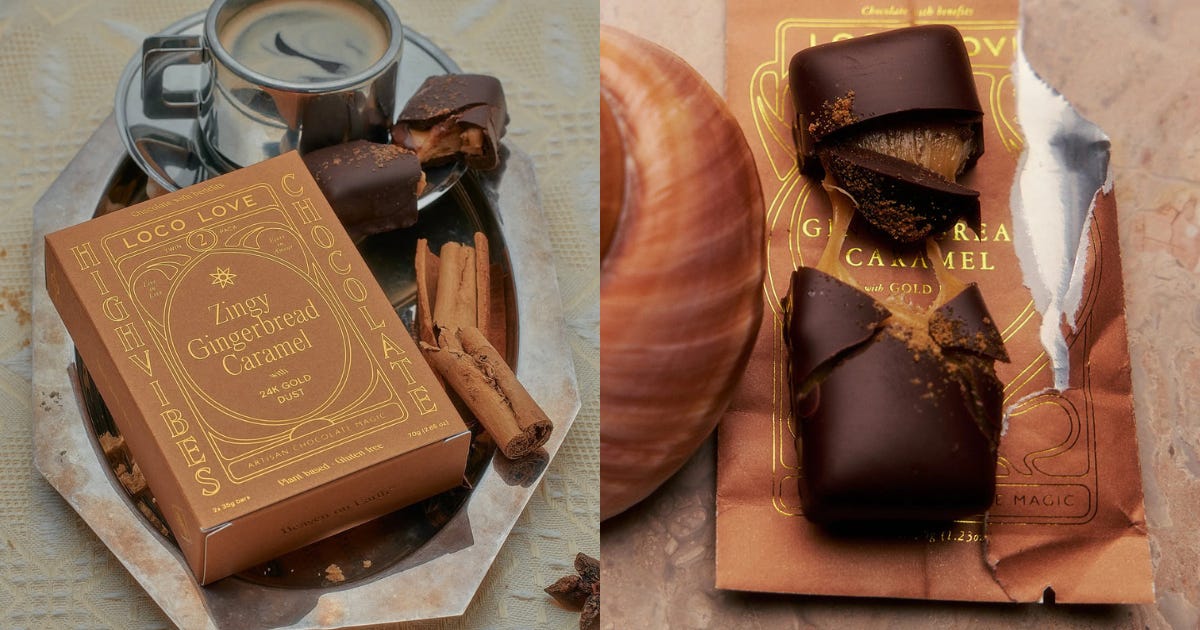
Loco Love makes chocolate to be eaten without apology. Its founder, Emica Penklis, is a naturopath. The bars carry no refined sugar and no dairy, and Penklis works with tonic herbs such as tremella and schisandra. Revenue rose from about A$8.8 million to almost A$12.8 million in a year, by the company’s figures. Its investor, the former Swisse chief executive Radek Sali, says supply is 23 percent short of demand.
That last number is the rarest in this series. Most brands in Part I and Part II were trying to prove demand. Loco Love cannot serve the demand it has.
But which part of the job is open?
Not the claim. Better-for-you chocolate became a big-company asset in 2021, when Hershey bought Lily’s for $425 million and Mondelēz bought Hu. Beauty chocolate is not new either: Sakara was promising visibly plumper skin in 2017. I discount Loco Love’s most functional-sounding line for the same reason. The “plant-based collagen” in its award-winning caramel, 2.8 percent of the bar, is broccoli and carrot juice extract. Plants do not make collagen, and a rival could print the phrase tomorrow.
What cannot be printed is what the trade actually rewarded. The Classic Chewy Caramel won Best Food Product at Australia’s Naturally Good awards in 2025, where the brand also took Retailers’ Choice. And what Penklis says customers come for is not a nutrient but “a real hunger for ritual, for slowness, for permission to actually enjoy something.”
That is the open job: indulgence that counts as care, carried by taste and ritual rather than by a claim.
Why hasn’t a major built it? Ask what a major could reproduce while keeping its economics, its scale and its credibility. Hand-made fillings strain the scale. Premium cacao strains the margin, at a time when, Loco Love says, cacao prices have tripled. And the voice may be hardest of all: no global confectioner could talk about love and intention with a straight face.
The hard part is also what growth threatens. The bars are still made by hand, and automation is planned. Penklis believes “food carries the energy of every hand it’s been touched by.” Her own philosophy ties the value to the very thing the new plant will remove.
THE LESSON
A job is open where it is hard to make, not where it is easy to claim.
02 — CONTESTED
The Hour Alcohol Used to Own
Two brands, two routes to the same hour
Jen Batchelor started Kin Euphorics from one premise: the drinking ritual itself was not the issue. That premise is the business case for a whole category. Only 54 percent of American adults told Gallup in 2025 that they drink, the lowest figure it has recorded. But the 6pm drink, the toast and the round were never only about alcohol.
Look at who buys the replacements. More than 92 percent of people who buy alcohol-free drinks also buy alcohol, according to NIQ. They are not converting; they are choosing by occasion. In this category the asset is not the ingredient. It is the moment.
Kin and De Soi took opposite routes to it.
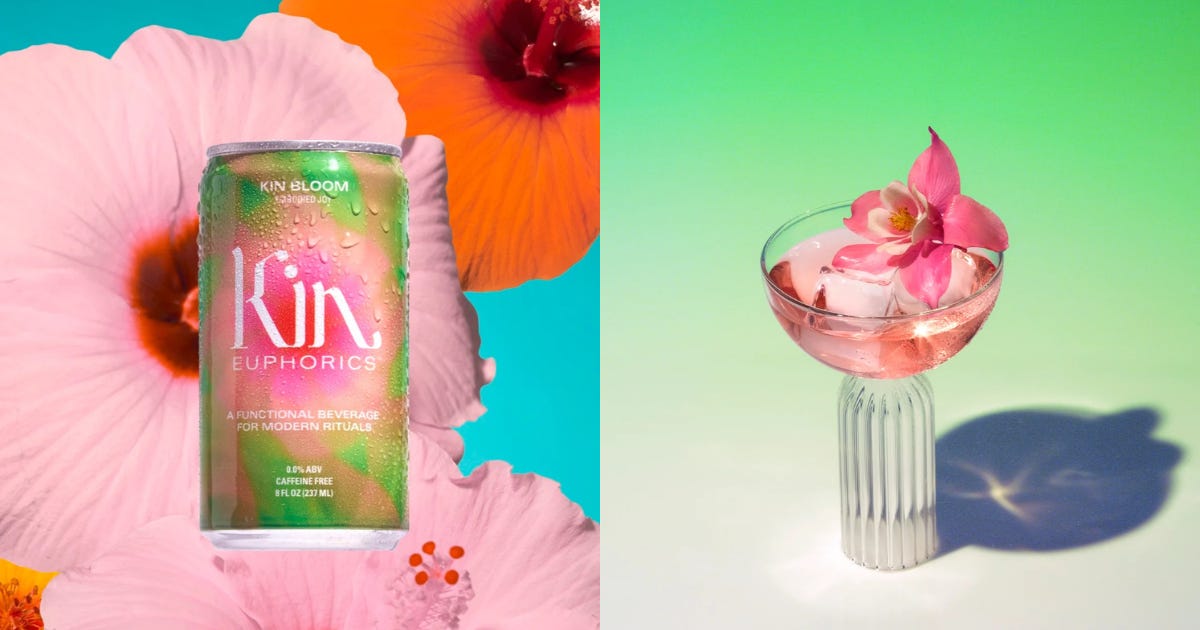
Kin sold states: drinks for morning focus, for energy and for relaxation. Batchelor calls it “the Spotify of beverages.” But states are easy to shelve, and Walmart now shelves them under a sign of its own.
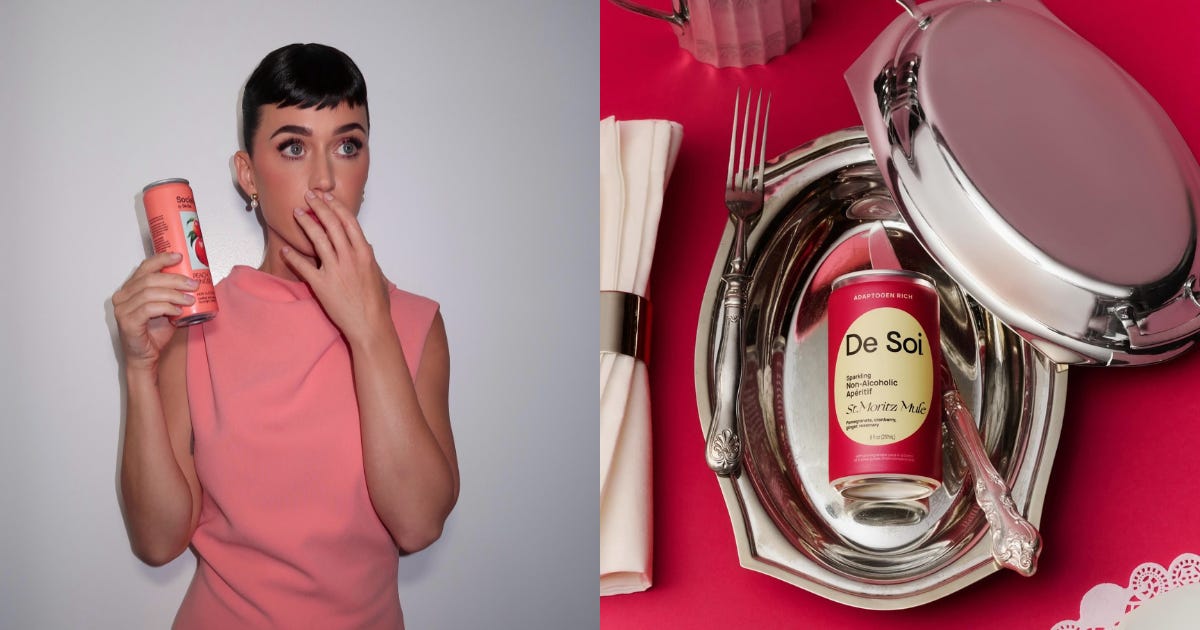
De Soi, co-founded by Katy Perry and the distiller Morgan McLachlan, sold moments. Its top sellers are Très Rosé and Spritz Italiano, alcohol-free riffs on drinks people already order. The riffs sell because they borrow an occasion that already exists. That is also their weakness. In 2025 Campari, which owns Aperol, brought its own alcohol-free spritz, Crodino, to the United States. The owner of the original ritual came back for the alcohol-free version.
Both brands have since moved into alcohol’s house. Kin signed with Southern Glazer’s, the largest US wine and spirits distributor, with bars and restaurants as its next frontier. De Soi sits beside alcohol at Total Wine and, by Forbes’s count, is in about 1,000 bars and restaurants. This summer it also launched Social Spritz, “for winding up,” a can Forbes compared with Celsius and High Noon. That is someone else’s occasion.
THE LESSON
An occasion borrowed from the incumbent can be reclaimed by the incumbent.The riff sells; the original keeps.
03 — EXPECTED
The Tin Everyone Learned to Draw
Fishwife, and what’s left once the code is learned
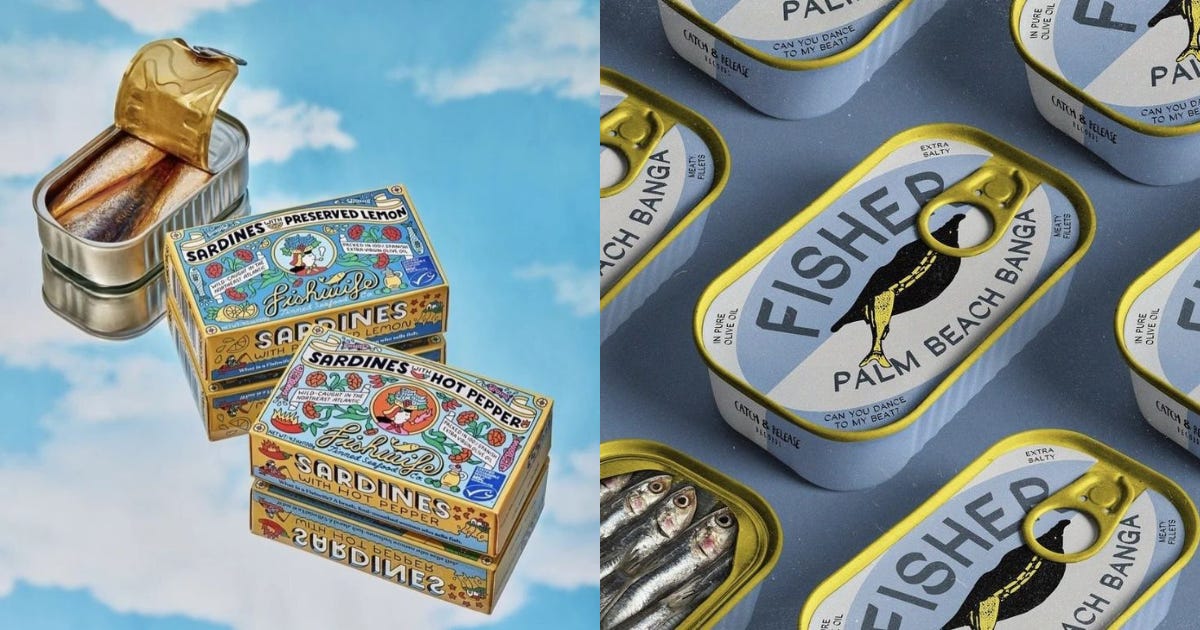
Fishwife launched in December 2020 to make tinned seafood, in its chief executive’s words, “a staple in modern American kitchens.” It worked. On Instacart, canned sardines’ share of items sold was up 51 percent year on year in the first half of 2026, and US shelf-stable seafood grew 15.2 percent by value in July, according to Circana.
Now look at who is growing fastest. Instacart’s figures for the brands leading the surge: Patagonia Provisions up 3,918 percent, Fishwife up 68.
Part of that is the tide: Instacart ties the protein surge to GLP-1 drugs, and a tin of fish is protein you can keep in a cupboard. Part of it is the code. The illustrated label, the flavor-forward tin and the dinner-party styling can all be learned. Even the fish is not exclusive: Fishwife works with six canneries in Washington State, Spain, Denmark and Scotland.
So what does Fishwife still own? Watch where it has put its defense. In January it began a nationwide rollout at Costco, at about $15 to $20 for a three-pack against more than $30 on its own site. In August, Aldi began selling it at a discount. It has put a co-branded tin on Sweetgreen’s menu and made Whole Foods’ first merchandise collaboration.
That is a rational defense. It protects the business with reach, price and a cultural network. It does not protect the premium. The centerpiece with a point of view is becoming a club-store multipack.
THE LESSON
You can teach the habit and still lose the repeat.
WHO GETS THE REPEAT?
The Tomorrow Test
Whether the loyalty you built is yours
Part II asked whether the behavior repeats. Part III has to ask who gets the repeat.
A customer can keep a habit and stop caring who supplies it. When that happens, the brand has built demand for the category and handed it the loyalty.
One question tells you which way it is going:
If an equally credible alternative appeared tomorrow at the same price, what would your customer miss?
If the honest answer is printed on your pack (the ingredient, the claim, the format, the look), the repeat belongs to the category. Those layers can be copied within a season or a product cycle.
An occasion takes longer, unless you borrowed it.
If the answer is something you do rather than something you print (a taste others cannot match at scale, a ritual, a relationship, the right to make the promise), the repeat may be yours. Those layers are harder to copy. Sometimes the only shortcut is to buy the brand that holds them.
This is where aesthetic wellness fools its founders. Four things look alike from the aisle:
A new look changes how a product is seen.
A new product changes what is in it.
A new job changes what it is hired for.
A new permission changes who can credibly be hired for it.
A new look or a new product can win a launch, but the next launch can copy both. A new job opens a vacancy. A new permission decides whose it is.
THE OBJECTION
Isn’t Being Copied a Win?
When imitation pays, and when it costs you
There is a serious case against all of this. If a job is valuable, imitation proves the market is real, and the inventor often wins anyway. PepsiCo agreed to pay $1.95 billion for Poppi. Hershey paid $425 million for Lily’s. Fishwife is profitable, by its lender’s account, and sells in Costco. Perhaps defensibility is overrated, and execution plus distribution is enough.
Sometimes it is. Being copied pays when you are the default at the moment the job becomes expected: the name customers say, the brand with the most shelf, the obvious acquisition. Then the category’s growth is your growth, and absorption is an exit.
It is dangerous when you are the teacher but not the default. You pay for the category’s education, and a better-distributed brand collects the repeat. Kin was early to mood. When mood got its aisle, the trade report named other brands.
So the question is not whether you will be copied. You will. It is whether, once the job is expected, it will be expected from you.
WHERE THIS LEAVES YOUR BUDGET
The old question was whether a job is valuable. The new one is whether it is still available, how fast it is closing, and whether the part customers would miss belongs to you.
That is no longer an observation. It is an allocation: the product you develop next, the claim you print, the occasion you spend to own.
So where would I actually put the money?
Below the line, I make the bets.
Three Second Jobs I would still fund today. One fast-growing opportunity I wouldn’t touch. And the four questions I’d ask before putting budget behind yours.
What’s still open. What’s already closing. What I’m willing to bet on — and what would make me change my mind.
